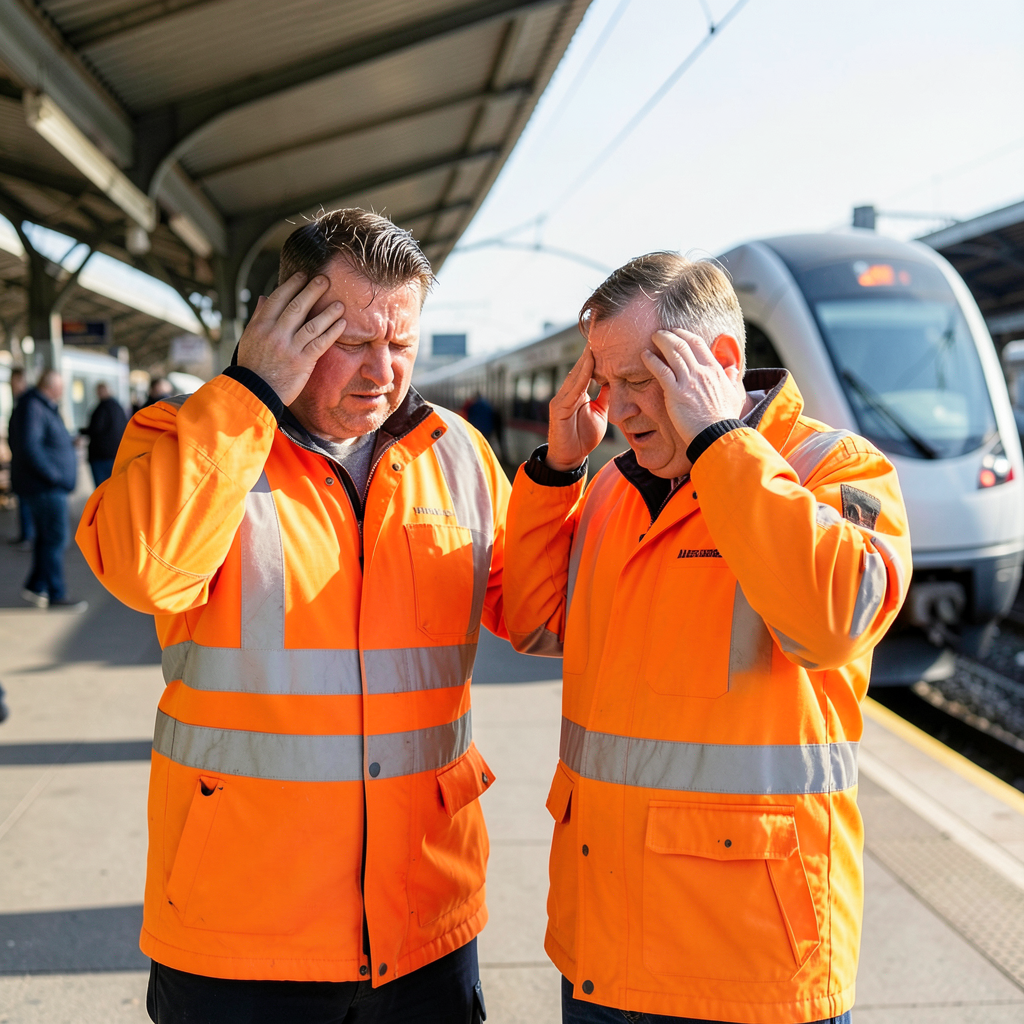

Rail workers in Nottingham have reportedly been sent home due to heat exhaustion while dealing with air conditioning problems on East Midlands Railway services.
An RMT Union representative states they are prepared to schedule additional strikes beyond the three Saturdays already arranged, as some employees report working in temperatures exceeding 40C on trains.
Jim Creamer, who serves as the RMT’s branch secretary for the Nottingham area, described how conditions have varied dramatically between carriages, with some completely freezing while others become unbearably hot. He noted that working in such extreme heat creates safety risks, particularly when staff become fatigued from the temperature.
The initial of the three scheduled Saturday walkouts occurred on August 1, with employees throughout East Midlands Railway taking industrial action over reported problems affecting the Class 810 Aurora train fleet.
The industrial action follows confirmation that EMR’s managing director, Will Rogers, would be departing the company.
East Midlands Railway maintains that the Class 810 Aurora trains only began operating after passing comprehensive safety assessments, yet the RMT union points to issues including breakdowns in communication links between drivers, dispatchers and trackside equipment.
Keir Chewings works as a train guard in Nottingham and represents the Midlands on the RMT’s national executive committee.
He described the Class 810 trains as experiencing multiple problems, including claims that staff cannot reach safety equipment in driver cabs. He highlighted that air conditioning units have failed to function properly, with employees forced to labour in 40-degree heat in galley areas, which he described as wholly unsuitable. He emphasised that train managers play a crucial role in train operations, meaning fatigue from the heat poses operational risks and potential safety hazards, as well as concerns for staff wellbeing. He confirmed that some employees have required time off due to heat exhaustion.
The three initial Saturday strikes primarily impact EMR’s intercity and connect services, which will operate solely between 7am and 7pm on the planned strike dates of August 1, August 8 and August 15.
Philippa Cresswell, EMR’s customer experience director, explained that the disagreement centres on concerns regarding the introduction of the new Class 810 Aurora fleet. She stated that any claims the trains fail to meet safety standards are inaccurate, as the fleet entered passenger service only after successfully completing all required testing and satisfying the stringent safety requirements set by the independent regulator.
However, Mr Creamer reported that concerns from staff have emerged every Sunday over recent months. He said workers have endured these problems for an extended period, noting they have experienced difficulties since the very beginning. He expressed worry about both employee safety and passenger welfare. He added that staff have limited options beyond halting trains at stations if conditions become hazardous.
The safety concerns meant some passengers at Nottingham Station backed the industrial action. Dave Goodliffe from Beeston observed that management had brought the situation upon themselves. He expressed understanding for the union’s need to take action, suggesting it was not a decision made lightly. While acknowledging the need for profitability, he felt trains remained fundamentally a public service and considered himself old-fashioned in that regard.
Jenni Harding, 75, from Newark, stated her belief that safety must be prioritised and systems should function properly. She expressed strong views about safety being paramount. Recalling her working days in London, she remembered boarding Underground trains that were sometimes old and noisy. She argued that if people are expected to give up road travel, which she supports, then safety must be guaranteed.
Beyond the three Saturday strikes, the RMT has initiated ongoing industrial action short of strike action, where workers decline overtime and filling in for absent colleagues.
Consequently, EMR reports that services could still face last-minute changes and cancellations on non-strike days throughout August.
Regarding the possibility of further strikes, Mr Chewings said the union takes members’ views seriously and remains willing to negotiate at any time and place to find a solution. He warned that should the company fail to engage constructively, the union would not hesitate to call additional action, though any decision would first be put to members as the union operates on a member-led basis.
EMR’s Philippa Cresswell stated that the company persists in working toward a resolution through constructive talks with the RMT.