It’s not usually open to the general public.
Bookmark
Comments
06:00, 2 AUG 2026
Bookmark
It’s a Nottingham building I’ve passed countless times. I’ve never been inside as it’s not usually open to the general public.
It would be easy to walk past the inconspicuous doorway of Bromley House Library, although recently the mock façade of bookshelves in the window of a former charity shop makes it more visible.
The entrance, in Angel Row, gives no clue to the scale of property, its history or what treasures lie behind the walls.
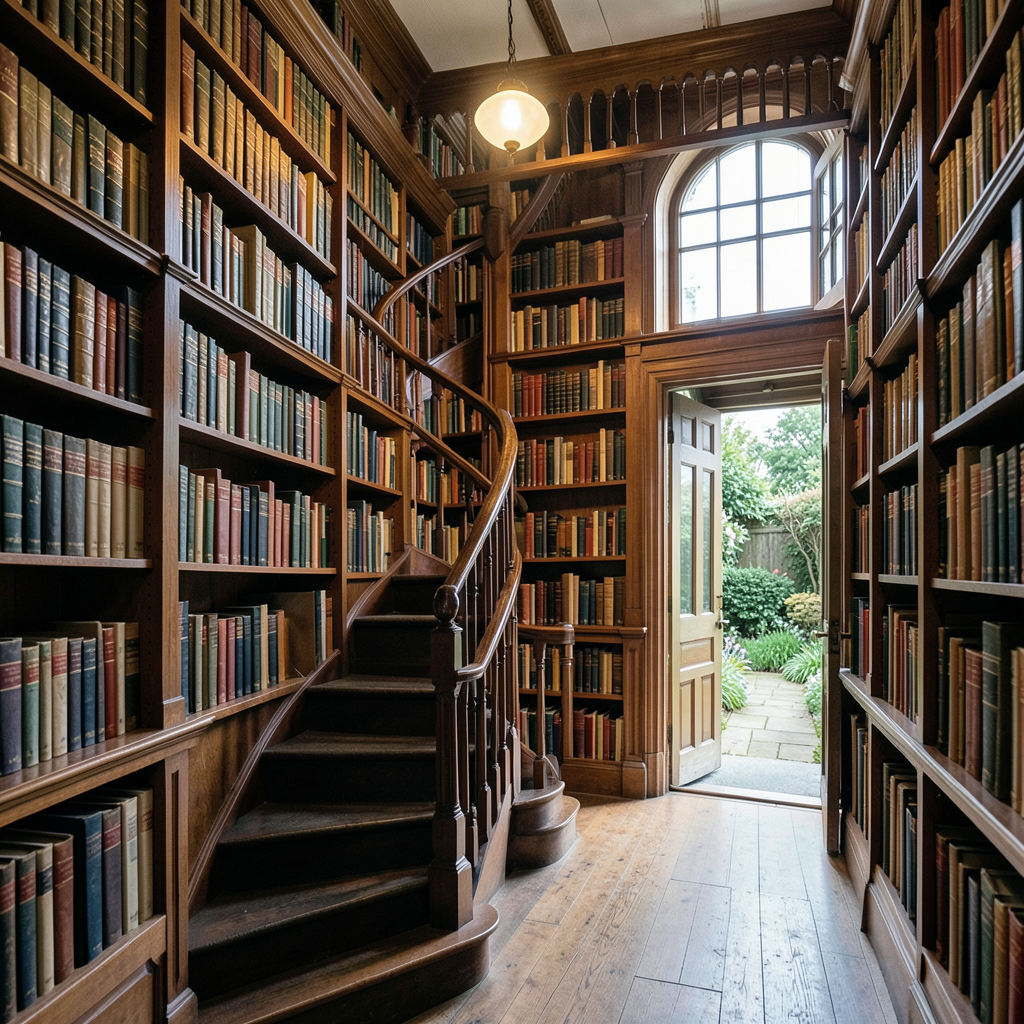
Bromley House was originally built as a Georgian townhouse in 1752, with sweeping staircases, before becoming a private subscription library in 1816.
With a labyrinth of rooms and corridors over three floors plus an attic, it would be easy to lose yourself in the historic Grade II listed building.
Even if you are not a member, it’s still possible to see behind the scenes, as occasionally the library runs guided tours. If you’re interested in books, history, architecture or just fancy a nosey behind closed doors, it’s a must.
Membership costs £186 for an individual or £248 for a couple but we paid £10 each to discover period features such as a spiral staircase, a Narnia-esque door from the children’s library, hear interesting tales and to check out a smidgen of the 57,000 books.
Because we’re early for our time slot, we wander around the hidden garden at the rear — one of just two of the remaining private gardens in the city centre — the other is behind Willoughby House, the shop of Nottingham’s famous fashion designer Paul Smith, in Low Pavement.
The walled garden boasts tall trees, a lawn and colourful flowers and there are plans to restore the garden back to its original glory.
Inside, the tour for around 10 of us, begins in the Thoroton Room, named after the historical and archaeological society, which has met there for decades.
The shelves here include Alan Sillitoe’s personal collection. The Saturday Night and Sunday Morning author’s taste was eclectic and he used to scribble notes on the pages — one example, in a book of Derbyshire walks, he wrote ‘it’s much better if you turn left at this point’.
Richard, a volunteer with an encyclopaedic knowledge of Bromley House, informs us that the library is not frozen in time. It adds around 1,000 books every year which presents the difficult decision of which volumes to sell off to make space.
We learn how the property was built as a private home for George Smith, whose grandfather founded Smith’s Bank (now NatWest) overlooking Old Market Square. The property also includes the former Barnardo’s charity shop to the left, a newsagent and Nando’s restaurant to the right.
The switch from Smith to Bromley came when his son changed his surname. A distant relative in the Bromley family had money but no male heirs, and as was common practice in those times, George adopted that as a surname to ultimately secure his inheritance.
Scandal, criminality, imprisonment, divorce and disputed legacies befell the family, forcing the family out of its home.
The property was leased to the city council and housed soldiers when the Luddites rioted before being put up for auction in 1820. Nottingham Subscription Library, in Carlton Street, relocated, paying the princely sum of £2,750 for the building and associated land.
At that time just a fraction of the rooms were used as a library — the rest of the building was rented out to repay the loan taken out to buy it.
Before heading up another flight of stairs to the attic, a glance over the bannister shows the floors from a dizzying perspective.
If you’re tall, you might have to duck in the attic, which was once the servants’ quarters, and later a photographic studio — the first one in the East Midlands. Now it houses history books including John Rushworth’s work of the English Civil War, published in 1629. Like many of the older books, the spine had totally gone but it was salvaged and replaced.
The library’s conservators go through a process similar to painting the Forth Bridge, but in this case dusting down books and checking for tears and damage.
Rooms display books, as diverse as The Life of Napoleon Bonaparte to Roald Dahl’s Charlie and the Chocolate Factory in the children’s library. It boasts a Very Hungry Caterpillar bookcase made by one of the members and a Narnia-esque cupboard.
Elsewhere the shelves are stacked with biographies, with juxtapositions as unlikely as John Major and Karl Marx. You’ll also find Adolf Hitler’s Mein Kampf and Dickie Bird’s autobiography.
The often-photographed spiral staircase was added in 1857 to connect the main room to an upper gallery that’s home to fiction.
Unusually, there’s no central support, each step rests on the next, so only one person is allowed on the creaky staircase at a time… unless there’s a fire.
Sitting in one of the comfortable armchairs in the Standfast Room, I spot books by Agatha Christie, while learning about the brass meridian line on the floor, dating back to 1836, which was used to tell local time before Greenwich Mean Time.
It was covered over for years before being rediscovered when a new carpet was fitted. Only four meridian lines are believed to remain in the country.
Richard regales us with tales about a billiard room which was closed in 1840 due to rowdiness and repeated complaints about the firing of guns and pistols. A few years later a baby was abandoned in the library.
The tour ends in the house’s original dining room, now named the Neville Hoskins reading room, which has a hidden passage behind a bookcase, although the public aren’t allowed to see it.
The original friezes and subject headings on the shelves remain — but there’s now LED lighting and we’re told to look up to the window from the street below on a late winter’s afternoon for a “wonderful” sight.
Matt Dolman, the library’s development manager, takes over to show some of the treasures, including one of the oldest books, The Divine Comedy, dating back to 1578.
Printed in Venice, it’s not known how it ended up in Nottingham but quite possibly was due to a trade or barter.
A first edition of Gerard’s Herbal, published in 1597, was lauded but it turned out he plagiarised much of his work. It contains one of the first recorded accounts of the potato in this country. Although you might want to take some entries with a pinch of salt, such as barnacle geese growing on trees.
Particularly delicate — Matt himself turns the pages — is Thomas Jowett’s herbarium of pressed flowers and plant specimens on the pages, presented to the library around 1822.
Amongst them Nottingham catchfly, a white flower growing in the wild, that almost disappeared from the city in the 20th century. It has recently been reintroduced to Nottingham Castle and the library garden.
A well-worn copy of D.H. Lawrence’s Lady Chatterley’s Lover dating back to 1932 is the expurgated version with all the raunchy sections removed. It wasn’t until 1960 that the full version could be legally bought after the famous censorship trial.
Bromley House Library is run by a charitable trust. Around 70 percent of funding comes from membership and the rest from rents, investments, donations and tours.
The library is more conspicuous at the moment due to the mock façade in the former Barnardo’s charity shop 1 of 14ShareComments
The library is more conspicuous at the moment due to the mock façade in the former Barnardo’s charity shop
Comments
Tall trees in the garden 2 of 14ShareComments
Tall trees in the garden
Comments
The garden behind Bromley House Library 3 of 14ShareComments
The garden behind Bromley House Library
Comments
The attic, which used to be a photography studio 4 of 14ShareComments
The attic, which used to be a photography studio
Comments
The George Green Room, named after the mathematical physicist, who owned Green’s Windmill in Sneinton 5 of 14ShareComments
The George Green Room, named after the mathematical physicist, who owned Green’s Windmill in Sneinton
Comments
The children’s library 6 of 14ShareComments
The children’s library
Comments
Some of the older books 7 of 14ShareComments
Some of the older books
Comments
The meridian line, once used to tell local time 8 of 14ShareComments
The meridian line, once used to tell local time
Comments
The spiral staircase has no central supporting column9 of 14ShareComments
The spiral staircase has no central supporting column
Comments
Thomas Jowett’s herbarium featuring pressed flowers 10 of 14ShareComments
Thomas Jowett’s herbarium featuring pressed flowers
Comments
The biggest book in the library next to the smallest (on the cushion behind)11 of 14ShareComments
The biggest book in the library next to the smallest (on the cushion behind)
Comments
The Divine Comedy is one of the oldest books in the library 12 of 14ShareComments
The Divine Comedy is one of the oldest books in the library
Comments
A picture of the library dating back to around 1900 13 of 14ShareComments
A picture of the library dating back to around 1900
Comments
The Neville Hoskins Reading Room 14 of 14ShareComments
The Neville Hoskins Reading Room
Comments
Things to do in Nottingham
Bygones