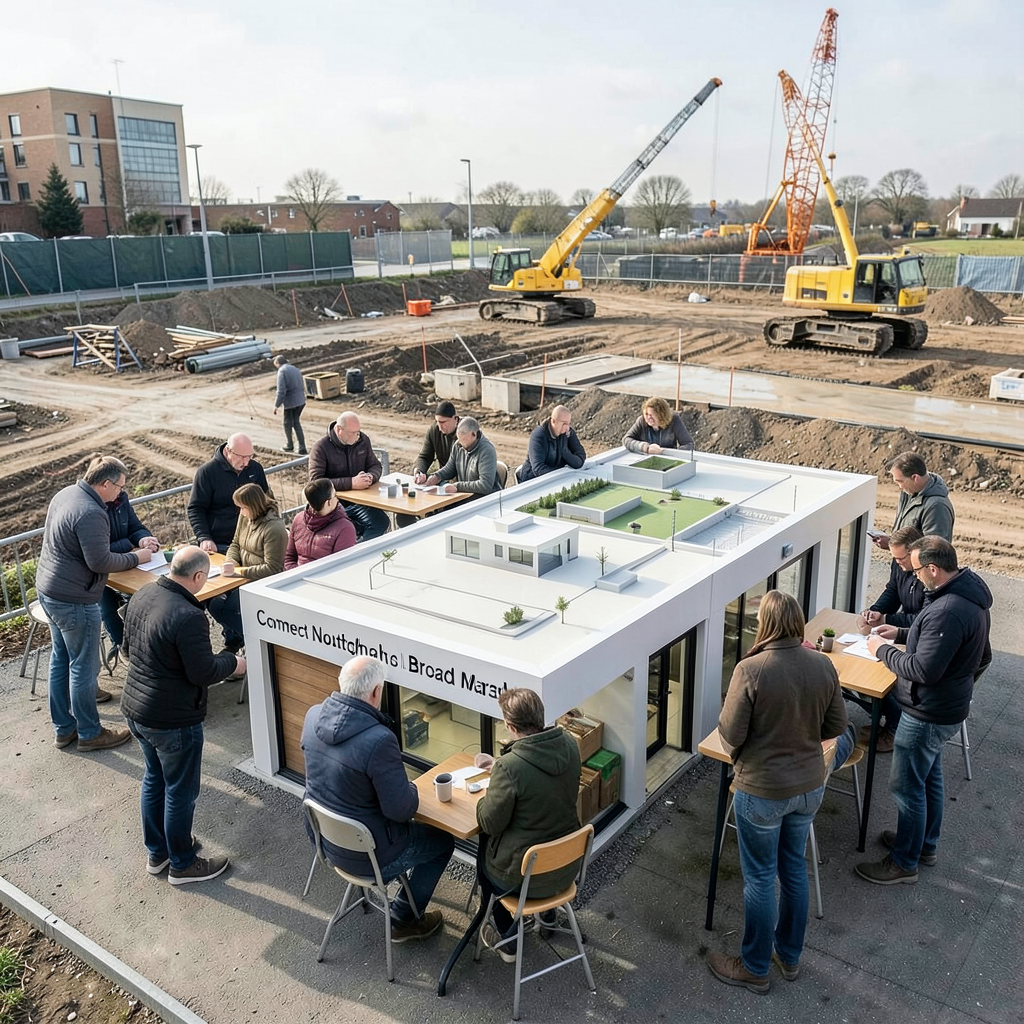

A public space for research, discussion and collaboration opened in Nottingham’s Broad Marsh redevelopment area following the official launch of Connect Nottingham yesterday.
The initiative was created jointly by the University of Nottingham, Nottingham City Council and Homes England, bringing together community groups, researchers, businesses and policymakers.
Located in the city centre, the project offers opportunities for direct engagement with research and consultations, the exchange of knowledge and ideas, and participation in discussions concerning Nottingham and the wider East Midlands.
It is the first completed element of the Broad Marsh redevelopment zone to open, making the new facility a visible presence amid ongoing work to transform the area.
Connect Nottingham was developed by combining the different experience, perspectives and connections of its partners.
Its purpose is to connect research with communities, policymaking and business activity.
The launch event was attended by Claire Ward, Mayor of the East Midlands; Councillor Neghat Khan, Leader of Nottingham City Council; Jo Nugent, Executive Regional Director for the Midlands at Homes England; and Professor Tom Rodden, Pro-Vice-Chancellor for Research and Knowledge Exchange at the university.
Professor Rodden explained that the project brings academic work closer to the people and locations that can benefit from it.
Residents are able to access researchers, contribute their own knowledge and help determine areas of investigation.
The facility also provides accessible opportunities for cooperation between organisations working in different sectors.
Three programmes operate within the Middle Pavement site.
Café Connect offers an informal environment for residents and others to participate in research by meeting academics, examining relevant subjects and contributing personal experience.
The Nottingham Urban Room provides a public setting for examining Nottingham’s history, current development and future direction, including discussion of the Nottingham Vision.
City as Lab continues place-based research through the application of data and digital innovation.
Existing City as Lab projects with a range of partners in Nottingham have established a foundation for its work at Connect Nottingham.
The programme uses geo-visualisation and additional data tools to support the study of climate change, public health, neighbourhood belonging, regional innovation and economic growth.
The findings are intended to help communities, researchers and policymakers understand complex issues affecting the city and region.
Each of the three programmes has access to a shared creative meeting area and a Digital Visualisation Studio.
Facilities within the studio include the Weston Immersive Room and the award-winning Projection Augmented Relief Model of Nottingham.
The latter was created through work between the university and the city council.
Dr Rebecca Ford, Academic Director of Café Connect, said the Garfield Weston Foundation had provided substantial funding.
That support enabled the creation of Café Connect and the Weston Immersive Room, described as a multi-sensory facility intended to encourage curiosity and participation while presenting research in an accessible form.
Ford said the combined facilities would enable a wider range of residents to contribute experience and expertise to relevant research.
Professor Paul Grainge, Academic Director of City as Lab, said three-dimensional technology could turn spatial information into stories and scenarios that reflected local conditions and remained accessible to the public.
He added that placing the model at Connect Nottingham would allow people to examine Nottingham, develop new questions and consider the areas in which they live and work from different perspectives.
The scheme extends an established partnership involving Nottingham City Council and the university.
Homes England also contributed to the restoration and redevelopment of the building.
Khan said the productive use of this part of Broad Marsh would attract additional visitors and complement recent property investment by partners on Bridlesmith Gate.
The council’s work with the university on City as Lab and the Urban Room has continued over several years.
With assistance from Homes England, the partners have restored and repurposed a former office in Severns House.
Principal capital funding came from Homes England, Nottingham City Council and the university, while the Garfield Weston Foundation also provided a charitable grant.
Operational assistance was supplied through the Higher Education Innovation Funding programme at UK Research and Innovation.
Nugent said the opening represented significant progress within the Broad Marsh programme and created a facility intended for Nottingham’s residents.
Homes England restored 20 Middle Pavement to provide premises where people could meet and discuss the city’s future.
She further described Connect Nottingham as the first public-facing entrance to Broad Marsh for several years and said the partners would participate in future discussions held at the site.
A commissioned artwork by Nottingham artist Natalie Coe has also been incorporated into the building.
Her work appears above the Digital Visualisation Studio and on the windows of the collaborative meeting area.
Although the project is based in Nottingham, its intended reach extends throughout the East Midlands and further afield.
It is designed to create links between local knowledge and academic research while contributing to broader conversations about innovation, the development of places and the future needs of communities.