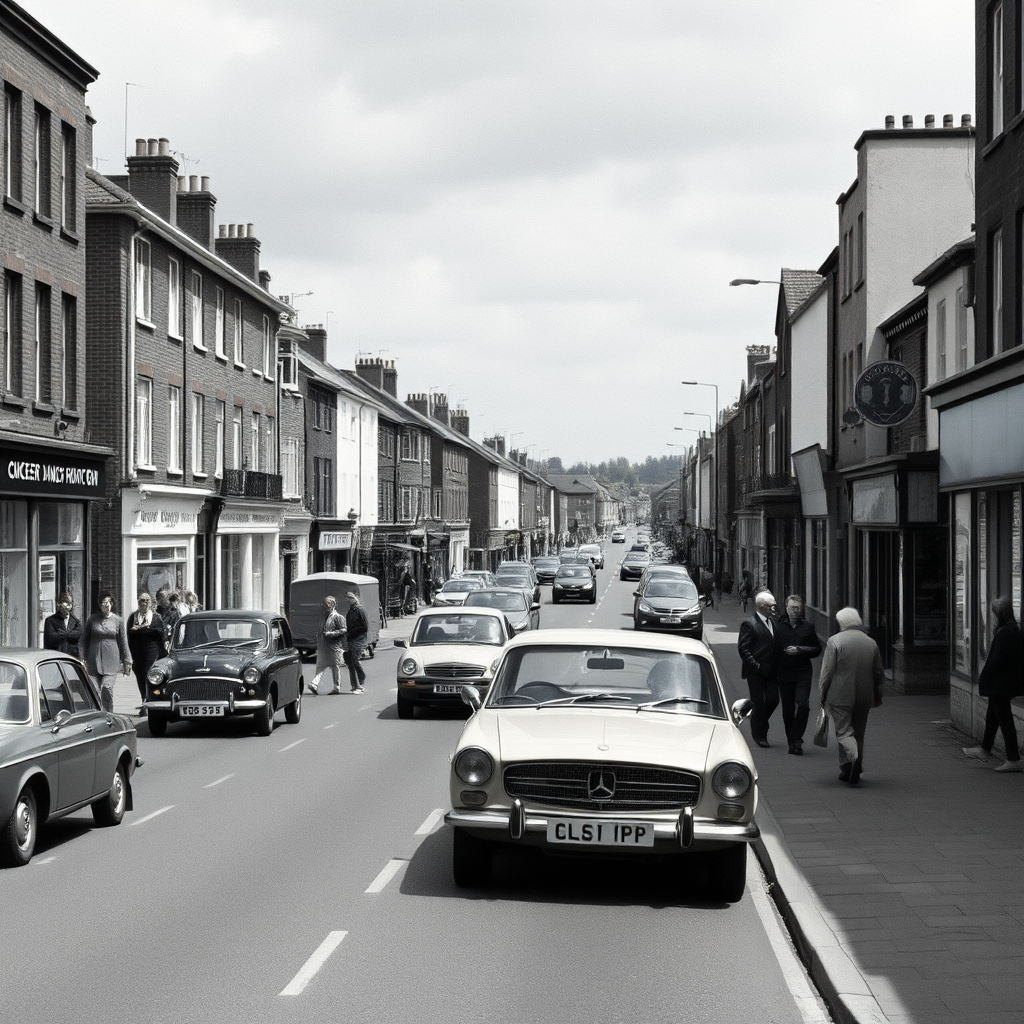

The city was undergoing a massive transformation at that time
Bookmark
Comments
06:00, 29 MAR 2026
Bookmark
Student photographer John Dean was just 20 when he flew from his home in America to spend a term at Nottingham’s Trent Polytechnic in 1976.
Over six months he roamed the city, armed with his trusty camera, to capture pictures of life on the streets in black and white — one of which scooped a prize from his local newspaper when he returned to Baltimore.
Just an iota of the thousands of photos are now being seen for the first time in Nottingham, at a free exhibition at Bonington Gallery, close to the darkroom where he originally developed his many rolls of film.
Recalling his exchange trip to the city where John left the classroom behind for a practical life lesson, he said: “What was great about what happened here, I was sort of a tourist and I wanted to meet people and this was a great way to do it.
“I adopted the role naturally as, being a tourist, I just went out, met people and photographed them. It was a different place and my job was to take pictures and I took every opportunity.”
Citing a quote from pioneering American photographer Ansel Adams, who captured the majesty of Yosemite National Park, “don’t take pictures, make photographs,” John added: “They were big on that at Trent as well. That’s what they drummed into our heads.”
John captured an important snapshot of Nottingham’s history during a time of profound social and economic change. By 1976, St Ann’s was deep into a radical restructuring as the densely packed Victorian slums were replaced with new homes and roads.
“It was a new experience for me to see the level of demolition that parts of Nottingham was undergoing at the time of my arrival so I found it interesting and important to document,” he said.
A more intimate glimpse into people going about their daily lives shows children playing amongst the rubble, a traffic warden at work, a pensioner and his dog in the park, a man looking at Rediffusion televisions to rent or buy in a shop window, youngsters playing hopscotch and people passing the time of day in Old Market Square.
Other shots are of the couple he lodged with at Corporation Oaks. Images show Alan and Christine at home, playing the guitar, sewing, making marmalade and celebrating their son’s first birthday.
Flares, platforms, patterned woolly jumpers and wide lapels were the fashion of the era. One of the most striking images, the first greeting visitors at the exhibition, is of a bunch of kids, some with grubby knees, sitting on a bench in Nottingham Arboretum.
A sign of different times, there were no parents around to ask for permission. It’s John’s favourite image and the one which took the prize when he returned home.
It’s not something a photographer would dare to do today. Although it’s not illegal to take photos of minors without parental consent, it could breach child protection.
The photo was taken using a large format 4 x 5 inch camera with a tripod and dark cloth over his head. Looking through the ground glass produced an image that was upside down and reversed. Other pictures were taken using a 35mm Olympus.
He’d love to trace the youngsters pictured, who would be in their 60s today. When he attended the official opening of the exhibition at Nottingham Trent University’s Bonington Gallery in Dryden Street last week, he met some of the people he’d photographed.
Around 40 framed photos are on the walls. For 50 years, the negatives were stored away until recently, when John began scanning the images, many of which were never printed.
His assistant of 25 years, Penny Forester, who curated the exhibition, whittled down the thousands of negatives to choose the best photos for the exhibition, entitled A Semester in Nottingham, 1976.
Now aged 70, John said: “I felt like I hadn’t really shown enough of what I did then as a student. They deserved to be seen,” said John, who has spent his life taking photographs and more recently shooting videos.
Other images in glass cases show the old Judge’s Bakery in Mapperley (now the Bread & Bitter pub), a professional wrestling match and Stonehenge.
The day after graduating from the Maryland Institute College of Art, John got a job at a commercial photography studio outside Washington DC where he photographed shop items for catalogues, from appliances to decanters.
He later took on assignments for the Walters Art Museum in Baltimore, which took him all over the world. One of the most memorable was photographing Hagia Sophia, a stunning building in the Turkish capital, Istanbul.
Considered one of the most extraordinary wonders of the world, it was founded as a Christian church, transformed into an Ottoman mosque, then a museum and is now again a place of Islamic worship.
John said: “I got to walk around the dome. Normally no one’s allowed up there. For many years it had the record for the largest enclosed space in the world so that’s pretty amazing. I thought, this is great. I love my job. I’ve had some wonderful assignments.”
Tom Godfrey, curator and director at Bonington Gallery, said: “It’s really caught the attention and imagination of the people of Nottingham. They have responded to it really well and recognised themselves and others in the photos.
“For me they show Nottingham as a place in a high degree of change — there were a lot of changes physically to the city at that time.
“Then it’s showing the people who are still having fun and enjoying the city, amongst all the change, embodied brilliantly by the kids playing on piles of rubble and just encountering the city as a playground. I can get a real sense of the characters.
“I think John, being a very gifted photographer, is able to compose an amazing-looking photo whilst also portraying the change which is happening.”
The exhibition can be seen until May 9.
Check out some of John’s photos in the gallery below.
A boy playing on the rubble around St Ann’s (Image: John Dean)1 of 12ShareComments
A boy playing on the rubble around St Ann’s
Comments
Redevelopment around Cranmer Street (Image: John Dean)2 of 12ShareComments
Redevelopment around Cranmer Street
Comments
A traffic warden going about his duties (Image: JOHN DEAN)3 of 12ShareComments
A traffic warden going about his duties
Comments
Wide lapels and patterned woolly jumpers were all the rage in the 1970s (Image: JOHN DEAN)4 of 12ShareComments
Wide lapels and patterned woolly jumpers were all the rage in the 1970s
Comments
A family pictured in the Arboretum (Image: JOHN DEAN)5 of 12ShareComments
A family pictured in the Arboretum
Comments
One of John Dean’s many subjects (Image: JOHN DEAN)6 of 12ShareComments
One of John Dean’s many subjects
Comments
A time of huge transformation (Image: John Dean)7 of 12ShareComments
A time of huge transformation
Comments
A man walking his dog in the Arboretum (Image: JOHN DEAN)8 of 12ShareComments
A man walking his dog in the Arboretum
Comments
Another shot in the Arboretum (Image: JOHN DEAN)9 of 12ShareComments
Another shot in the Arboretum
Comments
A group of kids playing on the cobbled street (Image: JOHN DEAN)10 of 12ShareComments
A group of kids playing on the cobbled street
Comments
John Dean as he is today (Image: Penny Forester)11 of 12ShareComments
John Dean as he is today
Comments
The exhibition at Bonington Gallery (Image: Joseph Raynor/ Reach PLC)12 of 12ShareComments
The exhibition at Bonington Gallery
Comments
Things to do in Nottingham